

Kathmandu – The recent attack on Iran by the United States and Israel has plunged the Middle East into crisis and has also disrupted Umar Ali Haider Ali’s used car business in Japan.
Haider Ali, who has lived in Japan for two decades, exports used vehicles from Japan to South Asia, the Middle East, and Africa. Due to strict Japanese regulations, these vehicles undergo regular inspections and maintenance, making them durable and desirable, with significant demand.
He reports that his vehicles arrived at Hambantota port over ten days late than scheduled.
Haider Ali’s challenges highlight how the Middle Eastern crisis and near closure of the Strait of Hormuz have deeply affected small businesses dealing in used vehicles from Japan and South Korea. These small enterprises collectively form a significant global industry.
According to Haider Ali, congestion at the port has caused some Japanese shipping companies to panic, leading to shipment cancellations or proposals to reroute cargo to Pakistan or China. One company demanded a deposit of $5,000 per vehicle. Some of his vehicles might need to return to Japan.
His Yokohama-based company, Kobe Motor, ships approximately 18,000 vehicles annually, mainly to Sri Lanka, where small Toyota and Honda cars are popular. Around 50 luxury vehicles, including Rolls-Royce, Lamborghini, and Ferrari, have been diverted to Sri Lanka and China since ships could not reach Dubai.
For some clients, air freight might be an option, but its high cost limits it to wealthier customers.
Last year, Japan and South Korea jointly exported used cars worth $19 billion, with Japan contributing more than half. Trade data shows that over a third of the 883,000 vehicles exported by South Korea went to the Middle East.
The United Arab Emirates was Japan’s largest destination last year, receiving 224,000 vehicles—about 15% of Japan’s total exports, according to the Ministry of Finance.
The Strait of Hormuz, between Iran and Oman, is critical for shipments passing through Dubai. If the conflict continues, exporters may face increased oil and shipping costs, currency fluctuations, declining auction prices, and reduced shipping routes.
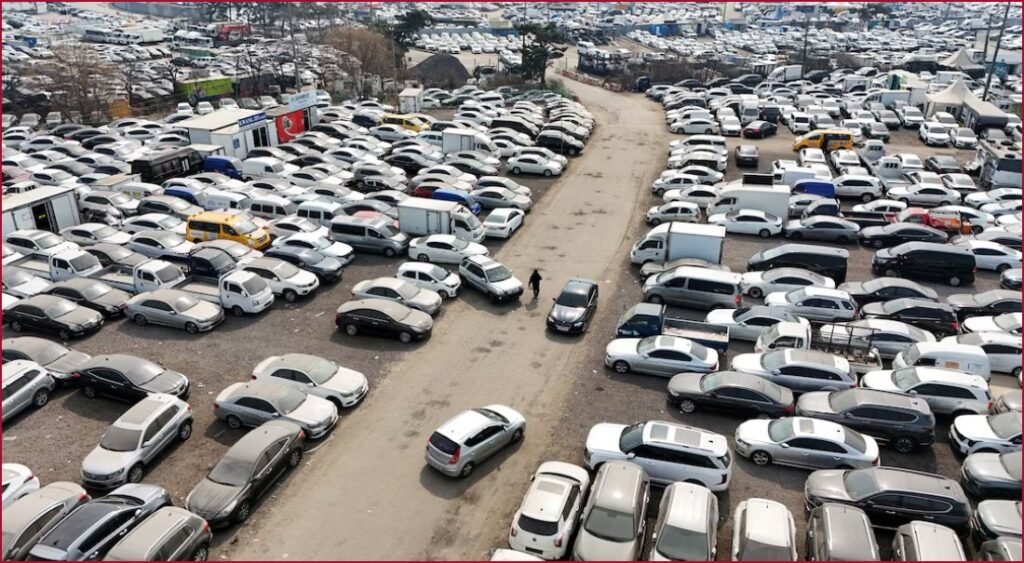
South Korea is also experiencing a halt in used car shipments during its busiest season due to the conflict. Demand typically rises from March to September when travel and construction activities in the Middle East and other regions increase.
Kang Tae-yang, an official from a shipping company, noted that activity at the Incheon port’s vehicle storage center has significantly decreased. Generally, about 80% of the vehicles from this port head to the Middle East. Currently, over 70% of the vehicles remain unsold in storage. Some ships have halted or changed destinations, with stored vehicles unable to move due to transportation disruptions.
Some ships are considering unloading cargo in alternative Middle Eastern locations or further ports to avoid the Strait of Hormuz. Shipping companies often make such decisions, while traders discuss alternative solutions.
“When war starts, waiting is all we can do,” said Jin Jae-woong, president of used car trading company Automobile International.
Models like Hyundai’s MD and Kia’s K3 are popular among Middle Eastern customers.
Jin noted that the conflict began just as prices were starting to rise. His company is spending around 40 million won monthly to store purchased vehicles in South Korea. He plans to buy vehicles in advance when the market is slow, anticipating a surge in demand once the conflict ends.
Some exporters are seeking alternative markets, but options are limited. “You can’t easily redirect shipments to Africa or Latin America,” said Yoon Sung-hyun, president of Ventas Auto, highlighting insufficient demand in those markets to handle additional sales.